
Oglethorpe County Court Records After Jail Arrest
After an Oglethorpe County arrest, the sheriff's side and the court side move on linked but distinct tracks. The sheriff's public roster can show the booking date, arresting agency, listed charges, and bond when that field is present. The court record starts when a warrant, citation, accusation, indictment, motion, plea, calendar entry, or other case filing reaches the Clerk of Superior Court, Magistrate Court, Probate Court, or the Northern Judicial Circuit District Attorney.
That distinction matters because a booking charge is not always the charge that ends up in court. Prosecutors may amend, reduce, add, or dismiss counts after reviewing reports and witness proof. For custody and booking context, use the Oglethorpe County jail inmate records page. For booking-photo limits, use the Oglethorpe County jail mugshots page. Court records after a jail arrest should be read from the clerk, court, prosecutor, and calendar sources.
Oglethorpe County Court Record Offices
The Oglethorpe County Clerk of Superior Court is the main office for Superior Court criminal filings. The county page identifies Kelli Smith, also listed as Kelli Paradise Smith, as Clerk of Superior Court. The office address is PO Box 68, 111 W. Main Street, Lexington, GA 30648, phone (706) 743-5731, with Monday to Friday hours of 8 a.m. to 5 p.m. The clerk's criminal division describes filings for misdemeanor and felony cases, citations, accusations, indictments, pleadings, bond forfeitures, grand jury presentments, Superior Court criminal cases, and warrants.
Magistrate Court is also central right after an arrest because it handles warrant issuance and early hearings. The county Magistrate Court page lists Chief Magistrate Judge Megan Coile, PO Box 356, 109 E. Boggs Street, Lexington, GA 30648, phone (706) 743-8321. Probate Court may be relevant for traffic matters, while felony and many misdemeanor prosecutions route through the Northern Judicial Circuit District Attorney.
Clerk of Superior Court
PO Box 68
111 W. Main Street
Lexington, GA 30648
(706) 743-5731
Monday-Friday, 8 a.m.-5 p.m.
Magistrate Court
PO Box 356
109 E. Boggs Street
Lexington, GA 30648
(706) 743-8321
Warrants, hearings, limited misdemeanors, and county ordinance matters.
Find Oglethorpe County Court Records After Arrest
The Oglethorpe Clerk of Court site has a Case Search link, Court Calendars, Court Info, Jury Info, forms, and legal notices. The research pass found that the official case-search endpoint returned 403 Forbidden, so the fields could not be inspected. That does not mean the clerk office is unavailable. It means the online link may block some environments, and the counter, phone, mail, and calendar pages remain part of the search path.
Georgia Courts e-access lists Oglethorpe Superior Court through PeachCourt, which requires login or registration. The statewide Georgia Magistrate Public Records portal was inspected too, but Oglethorpe County was not listed among participating counties or arrest-warrant search options. Readers who land there through a broad search should not treat it as an Oglethorpe court-record channel.
| Portal | Field Label | Type | Required | Notes |
|---|---|---|---|---|
| Oglethorpe Clerk Case Search | Not inspectable | Blocked | Unknown | Official link exists, but the endpoint returned 403 Forbidden during research. |
| PeachCourt access | User Name / email | Text | Yes for login | Account access path for Oglethorpe Superior records listed through Georgia Courts e-access. |
| PeachCourt access | Password | Password | Yes for login | Account access is required. |
| PeachCourt access | Human verification | Challenge | Yes | Login protection appears before access. |
| PeachCourt access | Register | Link/button | No | Account creation path. |
| Georgia Magistrate Public Records | County | Dropdown | Unspecified | Oglethorpe was absent, so this is not the Oglethorpe channel. |
The Oglethorpe Clerk court calendar page is a useful second source when a person knows a hearing date or case type. It lists criminal motion, trial, arraignment, calendar call, plea and sentencing, status, and other calendars by judge and date.
The clerk calendar source shows how Oglethorpe County court records after arrest continue beyond a roster entry.
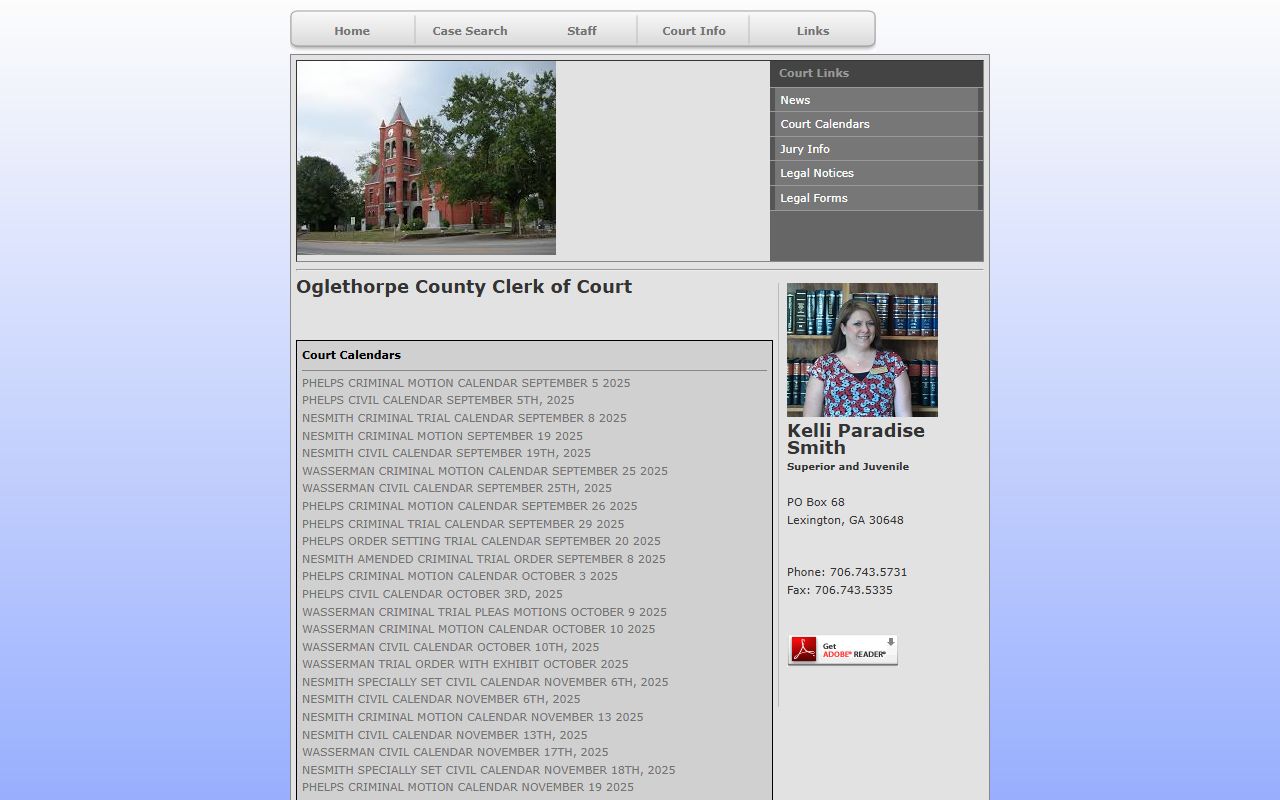
Calendar entries should be checked against the clerk office or an attorney because a missed setting can lead to a bench warrant before a new jail booking appears.
Oglethorpe County Arrest Charges Filed
The filing path after an arrest usually starts with jail booking, then first appearance and bond, prosecutor review, formal charge filing, arraignment, and later case events. Oglethorpe is in the Northern Judicial Circuit. The District Attorney's Office, led by D. Parks White, prosecutes crimes in the circuit. The Oglethorpe assignment listed by the DA includes Assistant District Attorney Charles Rettiger and Administrative Assistant/Victim Advocate Lauren Wright at 45 Forest Ave., Elberton, GA 30635, phone (706) 283-1716.
Formal court records after a jail arrest often turn on the charging document. The clerk's criminal division specifically references accusations, indictments, citations, criminal pleadings, bond forfeitures, and grand jury presentments. A roster charge may give the first clue, but the filed charge document controls what the court will hear.
| Document | Who Starts It | Common Use | What To Check |
|---|---|---|---|
| Complaint or warrant paperwork | Officer, affiant, or court process | Initial warrant, arrest, or early charge basis | Issuing court, offense date, warrant number, and bond terms. |
| Accusation | Prosecutor | Prosecutor-filed criminal charge, often without grand-jury indictment | Filed counts, amended counts, arraignment date, and plea deadlines. |
| Indictment | Grand jury | Felony charges and grand-jury presentments | Count numbers, offense levels, co-defendants, and later amendments. |
The DA contact page warns that defendants and family members of defendants, other than victims, must contact the defense attorney. The DA office cannot speak directly with them. Victims and witnesses should use victim-assistance channels and VINE notification rather than relying on defendant-only routing.
Oglethorpe County Charge Status Records
Charge status can change many times between the jail arrest and the final disposition. A charge may remain pending, be amended, be reduced, be dismissed, be nolle prossed, or end in a plea, trial verdict, or sentence. The Northern Judicial Circuit felony standing order uses arraignment as a key trigger date for motion and discovery deadlines, so the court calendar and filed docket can matter as much as the first booking entry.
| Status | What It Means | Where It May Appear |
|---|---|---|
| Pending | The charge is filed or active and has not reached final disposition. | Clerk case record, calendar, or court docket. |
| Amended or reduced | The prosecutor or court changed the charge wording, level, or count. | Accusation, indictment, motion, plea paperwork, or docket entry. |
| Dismissed | The court or prosecutor ended that charge without conviction. | Disposition entry, order, or court minutes. |
| Nolle prosequi | The prosecutor chose not to prosecute that charge. | DA filing, court order, or disposition field. |
| Convicted or sentenced | The person was found guilty or entered a plea and sentence was imposed. | Final disposition, sentence sheet, and sometimes GDC records after transfer. |
Note: When a case number is known, give the number to the clerk because name-only searches can miss spelling variants.
Bond and Warrants After Arrest
Bond is part of the court record as well as the jail release process. Georgia bail law under O.C.G.A. 17-6-1 directs courts to consider flight risk, public safety, witness intimidation, obstruction, the accused person's resources, and other factors. The Judicial Council misdemeanor bail bench card says initial appearance should occur as soon as possible and no later than 48 hours after a warrantless arrest or 72 hours after arrest on a warrant. Family-violence cases require judicial review before bail.
Oglethorpe County does not publish an official online active-warrant list in the sources reviewed. The Magistrate Court lists warrant issuance as a function, the clerk page says Superior criminal cases and warrants are scanned, and the sheriff's phone menu routes jail, reports, and records calls through (706) 743-8101. A bench warrant may exist even if the person is not yet on the jail roster, so missed court should be addressed through the court or attorney.
| Bond or Hold Type | How It Works |
|---|---|
| Cash or secured bond | Money or secured means posted to satisfy a court release condition. Local payment methods were not published. |
| Professional surety | A bonding company posts bond for a fee when allowed by the court and sheriff process. |
| Unsecured release | Release based on written promise and conditions when authorized under Georgia law. |
| No-bond hold | Money will not release the person until the court or holding agency resolves the hold. |
| Detainer | Another county, ICE, parole, state, or federal agency can keep a person in custody after local bond is set. |
Charges vs Convictions
Being arrested or charged in Oglethorpe County is not the same as being convicted. A charge is an accusation that must move through court. A conviction follows a guilty plea, trial verdict, or other final finding. Court records after a jail arrest should be read with that difference in mind, especially when the only starting point is a roster charge.
| Point of Comparison | Charge | Conviction |
|---|---|---|
| Stage | Accusation or filed count after arrest. | Final verdict, plea, or adjudicated result. |
| Proof level | Early probable cause or prosecutor filing decision. | Proof beyond a reasonable doubt or valid guilty plea. |
| Public meaning | Shows what was alleged, not what was proven. | Shows the resolved criminal judgment unless later restricted or corrected. |
| Where to verify | Clerk, Magistrate Court, DA filings, and court calendars. | Final disposition, sentencing paperwork, and GDC locator if state custody follows. |
Restricted Oglethorpe County Arrest Court Records
Georgia uses the term record restriction more often than expungement for criminal-history access. The Georgia Courts record restriction resource explains that eligible arrests or dispositions can be limited from public criminal-history dissemination. Older arrests before July 1, 2013 may use an arresting-agency and prosecutor process, and the agency fee may not exceed $50. Later arrests may be handled in a different court or prosecutor workflow.
Record restriction does not mean every court page, jail record, news item, or private repost vanishes at once. Pending investigations, juvenile material, sealed orders, victim data, protected personal information, and some prosecution records may be withheld or redacted under Georgia's public-record laws. Open records requests may also carry search, redaction, and copy fees under O.C.G.A. 50-18-71.
| Point of Comparison | Sealed or Restricted | Expunged |
|---|---|---|
| Georgia usage | Record restriction is the common Georgia route for eligible criminal-history access limits. | Often used as a general term, but Georgia resources frame most relief as restriction. |
| Public access | Public criminal-history dissemination may be limited for eligible records. | Do not assume local court or private copies are destroyed without a specific order. |
| Local records | Courts, clerks, prosecutors, and sheriff records may each have distinct handling duties. | Follow the specific order and confirm with the originating office. |
| Best source | Georgia Courts, Georgia.gov, clerk, prosecutor, and an attorney. | Case-specific legal advice, not a jail roster search. |
Open Records and Court Copies
Georgia's Open Records Act supports access to non-exempt public records, but it also allows lawful fees and exemptions. The Attorney General's open-government materials and O.C.G.A. 50-18-70 explain the broad access rule. Agencies may charge after the first 15 minutes of search, retrieval, redaction, and production time, and they must give notice if estimated costs exceed certain thresholds. Narrow requests tend to cost less and move faster.
For court-certified copies, start with the clerk. For sheriff booking, incident, or accident records, use openrecords@oglethorpesheriff.org. For prosecution-office records, the DA lists Hope Cobb, Chief Investigator, PO Box 515, Hartwell, GA 30643, phone (706) 376-3128, as the open-records contact. These offices should not be treated as one database. Ask the office that created or maintains the record.
Important: Records used for credit, employment, insurance, tenant screening, or other FCRA-covered purposes require a lawful consumer-reporting source.